
Contextual Narrative
Artist research


Maria Short
Maria Short, born in 196, is a photographer, writer and a Senior Lecturer in Photography at the University of Brighton. She was awarded a Bachelor of arts (honours) degree in Editorial Photography in 1995 and an Master of Arts in Sequential Design in 1997. Maria's long-term professional practice explores photographic portraits of the domestic animal and the ways in which the human-animal relationship is visually represented. Her pedagogic interest, the fostering of global citizenship through creative endeavour, is inspired by the work of the educator Daisaku Ikeda and his belief that, “the task of education must be fundamentally to ensure that knowledge serves to further the cause of human happiness and peace. Education must be the propelling force for an eternally unfolding humanitarian quest.”
In my opinion she captured what she intended to perfectly, the narrative is clear and you can see in the image that the subject and the horse have a Clear bond purely because of how the horse has his head resting towards her and how close they are,
Maria Short actually wrote her own book about Contextual narrative that highlight methods to help you with planning, developing and presenting meaningful, communicative images. My favourite quote fro her book is "However beautiful or technically dazzling your photographs might be, if they don't tell a story they are unlikely to make a lasting impression." and in a way she's right, if your images leave nothing to the imagination people will consider them bland. Maria has roughly 15 featured photographers, she goes through their work and explores the different narrative techniques and compelling concepts as well as showing you how to use this in your own work.
Over all the book seems very exciting, ill be taking some other inspirational artists from this book.

Weegee
Weegee, born on June 12, 1899 in the town of Lemburg (now in Ukraine), first worked as a photographer at the age fourteen, three years after his family immigrated to the United States, where his first name was changed to the more American-sounding Arthur. Self-taught, he held many other photography-related jobs before gaining regular employment at a photography studio in lower Manhattan in 1918. This job led him to others at a variety of newspapers until, in 1935, he became a freelance news photographer.
He centered his practice around police headquarters and in 1938 obtained permission to install a police radio in his car. This allowed him to take the first and most sensational photographs of news events and offer them for sale to publications such as the Herald-Tribune, Daily News, Post, the Sun, and PM Weekly, among others. During the 1940s, Weegee's photographs appeared outside the mainstream press and met success there as well. New York's Photo League held an exhibition of his work in 1941, and the Museum of Modern Art began collecting his work and exhibited it in 1943. Weegee published his photographs in several books, including Naked City (1945), Weegee's People (1946), and Naked Hollywood (1953). After moving to Hollywood in 1947, he devoted most of his energy to making 16-millimeter films and photographs for his "Distortions" series, a project that resulted in experimental portraits of celebrities and political figures. He returned to New York in 1952 and lectured and wrote about photography until his death on December 26, 1968.


In Balcony Seats at a Murder, Weegee captures police investigating the killing of a man who has just been killed outside his shop, while onlookers gawk at the scene from the tenement's fire escape. Weegee explains the image in his own words: "I arrive, right in the heart of Little Italy, 10 Prince Street, here's a guy who had been bumped off in the doorway of a little candy store. This was a nice balmy hot summer's night, the detectives are all over" weegee points out, in the rest of the comment, that on all the five stories of the tenement, people are on the fire escape. They're looking, some of the kids are even reading the "funny papers and the comics."
Weegee's interest in the whole scene enables him to create a narrative that focused on the surroundings and on the aftermath of the murder. Because of his ability to express the unfolding drama in one image, Weegee's photos became the perfect visual accoutrement for tabloid news. having photographed over 5,000 murders during his decade-long career as a crime photographer.

Gregory Crewdson
Gregory Crewdson, born in 1962 in Brooklyn, would eavesdrop on his father’s meetings: the psychoanalyst attended to his patients in the basement of the family home and Crewdson learnt early on about the abyss of the human soul, experiences which would later inspire him to his famous series “Beneath the roses” and “Twilight”.
There is something unreal and disturbing about Gregory Crewdson's photographs; Unreal because the theatrical composition of the scenes are undoubtful and disturbing because the characters featured in the picture always seem to be overwhelmed by doubt and regret this is recognisable through the obvious scenarios and body language.
The Twilight Series
The scenes in Crewdson photography are narrative-driven, if such word exists, and visually complex, which make them attractive to the viewer, who is compelling to explore them to decipher the stories hidden behind them. The narration is frozen in an instant of impasse, something has happened and something is going to happen. The light plays an important role in the scene, helping to create atmosphere (twilight) and remark the critical elements and characters. And the atmosphere is the key element in Crewdson photography.
Using the dim twilight, the narrative is disconnected from reality. Gregory did not narrate stories of everyday life and does not try to hide his intentions because he clearly uses a light that doesn't look natural. The poses and and behaviour of the characters also seem strange and unusual. there is defiantly something unreal about the situations although they could seem all too real to someone else.


Matisse by Henri.C.B
In the Studio is a series dedicated to the photographic documentation of artists within their workspaces. Over more than seven decades Magnum’s member photographers have captured images of the inner sanctums of many artists, often forging long-standing working or creative partnerships with them in the process. Henri Cartier Bresson’s relationship with the artist Henri Matisse began in unusual circumstances. Taken as a prisoner of war by the Germans in 1940, Cartier-Bresson escaped from a work camp on his third attempt in 1943 and went on to join an underground organization assisting prisoners. During this time, while the 36-year-old was hiding out in France, he was asked by the publisher Pierre Braun to photograph writers and artists for a book project that never materialized. This assignment led Bresson met some of the most prominent creative figures of the period. One of them was Matisse.
In 1944, Bresson would often visit Matisse’s villa in the Alpes Maritimes region of the country. The artist he met was by that time in his 60s and mostly chair and bed-bound. Though his physical restriction was frustrating, for Bresson, his art was always designed to soothe an aching body or mind – as Matisse explained: “What I dream of is an art of balance, of purity and serenity devoid of troubling or depressing subject matter – a soothing, calming influence on the mind, rather like a good armchair which provides relaxation from physical fatigue.”
Despite his declining health, in these photographs we see Matisse still busy sketching and painting the white doves that flap about his sun-lit room, as well as with portraiture – working with his regular models Micaela Avogadro and Lydia Delectorskaya.
Delectorskaya was a young Russian émigré who had been a companion of Matisse’s wife, Amélie, until she discovered the pair’s affair in 1939 and subsequently ended their 41-year marriage. Following the exposing of the affair Delectorskaya attempted suicide, but survived a self-inflicted gunshot wound and returned to working with Matisse for the rest of his life.


Idea Development
Henri.C.Bresson's photography has really struck a chord with me. The idea of photographing an Artis at work really appeals to me. As an Artis myself, I feel like I can relate on a higher level as it takes great concentration to ignore the things around you, speaking from experience, especially if you get distracted easily. It takes a lot of focus and hand/eye coordination. Its also quite fascinating to see an others mind at work, Putting thoughts to words is simple enough but putting thoughts to an intricate design is a different kind of skill.
Hopefully "Artist photography" will be my main idea though my back up idea I will be street photography, Its one of the more simpler forms of contextual narrative but there are never two photos that are the same, This would be fun to test with however I could get a lot of angry glances when out in the field. Not many people like to be photographed especially not by strangers. In conclusion I could of used a subject amongst some crowds so that pedestrians don't think they're being photographed this would avoid any conflict or disturbances when photographing.
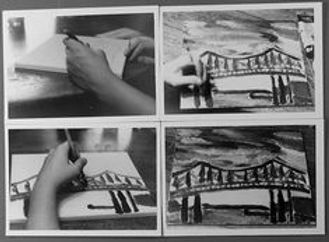
for example, I would say that this is a clear contextual narrative of artist photography because you can clearly see the stages in which the art is progressing into completion. this is the kind of style I wish to achieve in my own work, this shouldn't be to difficult to achieve as I know plenty of artist the would more then likely help me on this project (they will also be featured.

I wouldn't say this is a perfect example of contextual narrative in street photography this is the kind of style I want in my own photography, the image has a lot of personality. Its well presented. The depth of field also gives the entire photo some sort of narrative. I'm quite fond of This image personally I would love to go out and capture this kind of thing but travel isn't my strong suit. Though that is more of location photography.
Assignment photos
Like Henri C.B I have chosen to shoot from an artist point of view I found that shooting in a series wasn't as difficult due to it just being a photographical record of what someone has done, in this scenario I have staged this with my own art and used a muse to look as though they had composed it, being a person of different genres I felt as though my other skills were being featured and that it was more of a self record.
This series of images were the better outcome of the whole shoot, I felt like these show a clearer narrative and are presented nicely with the same camera angles as well as editing, I tried to experiment with different camera angles but came to the realisation that if they weren't all the same angle they wouldn't work together. out of approximately 20 images I narrowed it down to just 4.


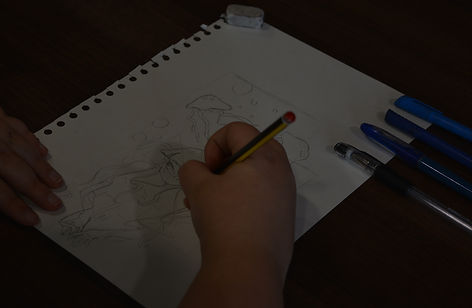
Below are two images I didn't use. I refused to use these images primarily because of the way they were angled this is due to the drawing and how the hands cover majority of the art this did not correlate well with my final idea and the whole purpose of it was that the art piece was on show so naturally I didn't use them, However these images wouldn't have been usable without heavy editing as the lighting was poor making the images darker then they needed to be.

Essay
The Entire purpose of this assignment is to present my imagery, work, research and accomplishments, how I've been able to develop from the very start to the complete end in hopes that it all makes sense. The idea of artists at work gave me the opportunity to show just how far I have come from knowing little to developing and experimenting as well as applying it to my own work. Henri Cartier Bresson's series dedicated to the photographic documentation of artists within their workspaces. Especially his work with the famous artist, Matisse inspired me greatly. His classic black and white images are to be expected for a man of his time and of course the available resources, coloured cameras were very unheard of. There is always something so elegant about his photography that I don't understand but it continues to draw me in continuously. I was very nearly tempted to edit my images to black and white as a clear correlation but I decided against it this was difficult but the colour contributes to more of my research especially the work of Gregory Crewdson and his "Twilight series" through my research his work is said to be "disconnected from reality" as strange things happen in the twilight, this for me was a really exciting series although the colours seemed dull in some images in others it they are vibrant in the 'moon light' of course this wouldn't be natural moon light as the images were taken in a studio though the use of a spot light worked incredibly well with what he wanted to convey, I found this inspiring and eye opening especially to my own work on contextual narrative so I decided to develop and explore with my own creativity with a drawing of a jellyfish woman. I wanted my work to be bold but subtle so that the viewer had to really look at the drawing in order to understand. There is no particular meaning behind the woman but simply my love for jellyfish, this could also be considered strange and disconnected from reality as it is putting a thought to pencil and paper, this piece I am particularly proud of.
In my opinion I have captured my content successfully, there is a clear contextual narrative through all four images as the stages of the drawing progress this is clear and also noticeable by the stages of colour, overall build-up of the image and drawing. Through the change of pens and pencils as well as the cut of the bits of paper there is a clear shift throughout the stages in the images to show the viewer clear movement throughout the series. I feel like the presentation method was basic but subtly charming this is shown by the organisation of the pens around the artist and the artist's work as well as the camera angles used, they were all the same if not very similar I did however experiment with a few camera angles and overall, out of twenty images the ones I was most fond of are the ones I used and edited. There were a few minor lighting issues but once I adjusted the ISO the lighting wasn't a problem just took some light editing, I used photoshop to edit not only the lighting I also heightened the contrast to give the image bolder colours and deeper shadows. My shots came together smoother than I expected there was no need to recapture anything. I personally loved how my shoot turned out and it conveyed everything I wanted it too.
Throughout my entire project I had some stable areas but also some weak areas. In the stronger aspect; visual content and research were my strongest aspects, in general I enjoy researching and making over all conclusions and giving opinions, research came to me naturally as well as having a backup idea already in mind, such as street photography. In a weaker aspect, location, and equipment, although I took my images on collage grounds everything has become a lot more difficult due to COVID restrictions and personal safety in general, there aren't a lot of options on where to take photos at the moment especially for location-based photographers due to borders being closed. Using a camera with a mask however was proven more of a struggle than I anticipated, when holding the camera to my face the mask would often ride up my chin when squinting through the lens or it would get uncomfortably hot fast, I managed to make it work however and got some awesome shots. COVID has become a huge issue globally, in my local area and at collage so to abide by the restrictions I did this shoot as safely as possible making sure my subject was absolutely okay within distance of me and of course okay to be photographed.
Receiving previous feedback my work has had a positive outlook on my viewers they have a clear understanding of the progress and development of the assignment as well as an immaculate viewing of my own originality in the images which separates them from my inspiration. My assignment has been considered a different approach to contextual narrative, said to be "out of the box" and unexpected by viewers with is one of the best compliments I could possibly receive considering my assignment is supposed to be seen as different and unusual, I couldn't have asked for better feedback. I am overwhelmed with the outcome of my assignment. It gave me the opportunity for me to express my own creative ideas and merge them with my passion for photography which is what I wanted in the beginning. I would not change anything about my project. I couldn't have done any better than what I have already achieved, which in fact, was everything I wanted to achieve and more. On a personal level this is outstanding, I'm truly getting somewhere with my studies, I couldn't be happier with the work I have produced.
Leah: I like how you have added your own original touch to the images as it gives it separation to the inspiration. you can clearly see that you thought about you idea thoroughly before creating the photos which clearly show the progress of the drawing. the fact that you added you own opinion about each artist work is great as I shows just how much thought you have put into each bit of research and inspiration. overall, think the project is great.
Rich:An interesting aspect to approach narrative, there has been clear considerations to what you may want to achieve within this project. You have produced work that would not be expected as such thought about the process, it's great to see you thinking outside the box. The work is original and as such holds further through to the viewer.